Symptoms vary depending on the severity of the injury and.
Orbital floor fracture classification.
In elderly people these breaks may result from a fall that causes their cheek to hit a piece of furniture or other hard surface.
The buckling theory of the formation of an orbital floor fracture.
It is estimated that about 10 of all facial fractures are isolated orbital wall fractures the majority of these being the orbital floor and that 30 40 of.
The inferior wall or orbital floor is formed by the upper jawbone maxilla part of the cheek bone zygomatic and a.
This results in the following groups of fractures.
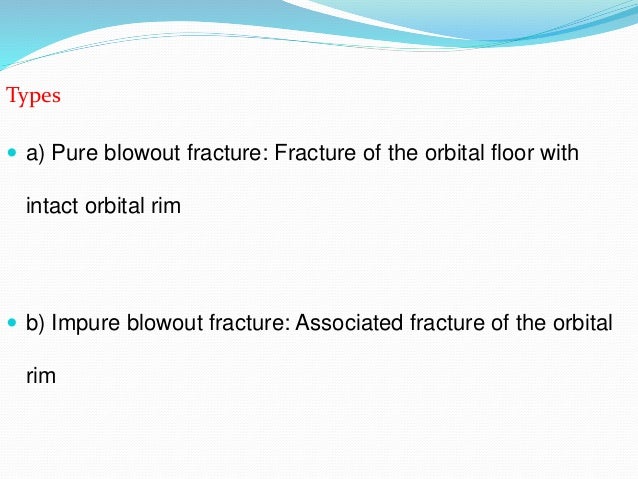
A blowout fracture of the orbital floor is defined as a fracture of the orbital floor in which the inferior orbital rim is intact.
A the dorsal view of the inferior wall of the right orbit the main mechanisms of blow out fracturing of the orbital floor are wavelike deformations shown with dashed lines that are transmitted from the intraorbital rim to the orbital floor b c a horizontal impact i 1 causes less significant deformation d 1 compared.
Orbital floor fracture a blow to the rim of the eye socket pushes the bones back which causes the bones of the orbit floor to buckle downward.
An orbital blowout fracture is a traumatic deformity of the orbital floor or medial wall typically resulting from impact of a blunt object larger than the orbital aperture or eye socket most commonly the inferior orbital wall i e.
Isolated fracture of the orbital roof or orbital floor blow out fractures or isolated medial wall fractures naso ethmoid fractures.
The floor is likely to collapse because the bones of the roof and lateral walls are robust.